


Check valves
KTN Valves is a European check valve manufacturer based in Rubí (Barcelona), Spain. A check valve, also called a non-return valve, is the only valve family that operates on its own: line pressure opens it and reverse flow closes it, with no operator and no actuator. KTN manufactures piston, swing and wafer disc and dual plate check valves to API 594 and API 6D.
Filter
Showing all 12 results
-

CHECK VALVES WAFER DISC TYPE
-

CHECK VALVE WAFER TYPE DOUBLE DISC
-

BSP VERTICAL CHECK VALVE METAL CLOSURE
-

CHECK VALVE WITH ANSI FLANGES
-

FORGED STEEL CHECK VALVE WITH ANSI FLANGES
-

FORGED STEEL CHECK VALVE WITH THREADED ENDS
-

CHECK VALVE WELDABLE ENDS IN FORGED STEEL
-

CHECK VALVE THREADED ENDS
-

CHECK VALVE CLASS 800 WITH WELDABLE ENDS
-

SWING CHECK VALVE WITH WAFER CONNECTION
-

CHECK VALVE IN STAINLESS STEEL WITH ANSI FLANGES
-
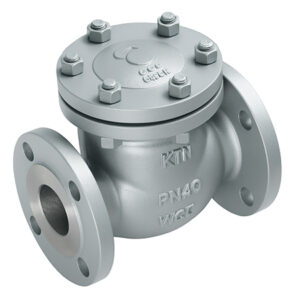
CHECK VALVE CARBON STEEL BODY DIN FLANGES
Ask a quotation
Request a quote for check valves: tell us the DN, material, mounting type (wafer, lug or clamp), seat, pressure and temperature and we will send you a customized offer with the best price and lead time.
Check valves
CHECK VALVES GENERAL DESCRIPTION
| Item | Specification |
|---|---|
| Manufacturer | KTN Valves (Kara Technology News, S.L.), Rubí, Barcelona, Spain |
| Types | Piston, swing check, wafer disc and dual plate |
| Materials | AISI 316/316L, carbon steel WCB, forged A105 and F316 |
| Connections | ANSI B16.5 flanges, EN 1092-1 flanges, BSP and NPT thread, BW/SW, wafer |
| Size range | DN15 to DN500 |
| Design standards | API 594 (wafer and dual plate), API 6D, ASME B16.5, EN 1092-1 |
| Certification | ISO 9001, Bureau Veritas inspection, certificate of origin, 3.1 material certificate on request |
What a check valve is and what it is used for
A check valve lets fluid pass in one direction and blocks it in the other. The disc lifts under the working differential pressure and returns to the seat as soon as flow drops or reverses. No other industrial valve family works without an operator, an actuator or a control signal. It is also called a non-return valve.
Its usual job is protecting upstream equipment. When a pump stops, the fluid column tries to run back: without a check valve the impeller spins in reverse and the line drains. On headers with several pumps in parallel, the running pump would feed the stopped one. Compared with an actuated shut-off valve, a check valve closes at the exact moment flow reverses, with no dependence on control logic or instrument air.


Check valve types and when to use each one
KTN manufactures the three construction types used across industrial duty:
Type | Closing action | Mounting | Strength | Water hammer |
|---|---|---|---|---|
Piston | Axially guided disc, spring loaded | Horizontal and vertical | Small bore, high pressure, class 800 | Low |
Swing check | Hinged disc, gravity and back flow | Horizontal or vertical upward | Large bore, lowest pressure drop | High |
Wafer disc and dual plate | Half discs with spring | Any position | Compact between flanges, API 594 | Lowest |
- Wafer check valves: single disc and dual plate to API 594, spring assisted closure.
- ANSI flanged check valves: swing or piston type, class 150-300.
- DIN flanged check valves: EN 1092-1 in carbon and stainless steel.
- NPT threaded check valves: forged class 800 piston type, small bore.
- BSP threaded check valves: vertical execution for risers, ISO 228.
- Butt weld and socket weld check valves: forged class 800 for steam.
Water hammer and cracking pressure
Water hammer occurs when the fluid is already travelling backwards and the disc stops it abruptly. The surge grows with the reverse velocity reached before closure, so the disc design decides how hard the line is hit. A large swing check disc travels almost 90 degrees pushed by the reverse flow itself: by the time it reaches the seat the column is already moving backwards, and the sudden stop sends a pressure wave down the pipe. A spring loaded disc travels a few millimetres and seals close to the zero flow instant, so the surge is far smaller. On long pumped mains, a spring loaded dual plate valve punishes the system least.
Cracking pressure is the minimum differential needed to lift the disc off its seat. A gravity operated valve opens with almost no differential; a spring loaded valve needs more, and that penalty stays for the whole service life, eating into pump head. In vertical mounting the spring also overcomes disc weight. Selecting a spring trades water hammer against pressure drop.
Mounting orientation
Every check valve carries an arrow cast on the body showing flow direction, and fitting it the wrong way round blocks the line or disables the non-return function. Position matters as much as direction: swing checks and unsprung piston checks rely on gravity and only work horizontally or vertically with upward flow. Spring loaded wafer disc and dual plate designs work in any position. Allow a straight run upstream of 3 to 5 pipe diameters after an elbow or a pump, or the disc flutters and wears the hinge.
Materials and seats
KTN builds bodies in stainless steel AISI 316/316L, carbon steel WCB and forged A105 and F316 in class 800. The seat is ground metal-to-metal for steam, hydrocarbons and high temperature, or fitted with an elastomer insert in the disc for tight shut-off at low differential on water networks. Springs and hinge pins are stainless steel to avoid corrosion failure, the most common defect without maintenance.
Connections and standards
The range covers ANSI B16.5 flanges class 150-300, DIN EN 1092-1 flanges, BSP thread to ISO 228, NPT thread to ASME B1.20.1, socket weld to ASME B16.11, butt weld to ASME B16.25 and wafer mounting. Wafer disc and dual plate executions follow API 594; pipeline executions follow API 6D. Use the DN to inches conversion table and check the flange face types.
How to select a check valve
- Objective: against water hammer, dual plate or spring loaded disc; against pressure drop on large bore, a flanged swing check.
- Space: a wafer valve takes a fraction of the face-to-face length of the equivalent flanged valve.
- Position: confirm horizontal, vertical upward or downward mounting before choosing the type.
- Pressure: class 150-300 flanged, class 800 forged threaded or welded.
- Material: AISI 316 for corrosives, WCB for water, metal seat for steam.
Applications and industries
KTN check valves protect pumps and compressors in petrochemical, chemical, oil & gas, power generation, steam, water treatment, fire mains, food and beverage, mining, marine and HVAC. They sit on every pump discharge and on parallel headers.
Buying check valves direct from the manufacturer
Buying from KTN means buying at the factory gate: stock of common sizes and materials for immediate despatch, a certificate of origin with every order and special executions to drawing. Send DN, type, material, connection, differential pressure and mounting position and the technical team returns price and lead time. Distributor enquiries are welcome.
Why KTN
KTN Valves (Kara Technology News, S.L.) manufactures in its own plant in Rubí, Barcelona, under an ISO 9001 quality system with Bureau Veritas inspection. Every shipment carries a certificate of origin and, on request, a 3.1 material certificate.
Related categories
Pair check valves with the isolation duty of ball valves or gate valves. For flow regulation, see globe valves. For economical large bore isolation, butterfly valves. Protect the valve with a Y strainer. The full range is under industrial valves.
Frequently asked questions
Which check valve type best prevents water hammer?
Dual plate and spring loaded wafer disc types. Their disc travels a few millimetres and seals close to the zero flow instant, before the column builds reverse velocity. A swing check has to travel almost 90 degrees pushed by the back flow, so it closes later and produces a much larger pressure surge on long lines.
In which position should a check valve be installed?
Always following the arrow cast on the body, which shows flow direction. Swing checks and unsprung piston checks work only horizontally or vertically with upward flow, because they rely on gravity. Spring loaded wafer disc and dual plate types accept any position, including vertical downward flow.
What is cracking pressure and why does it matter?
It is the minimum differential pressure needed to lift the disc off its seat. A spring raises it, and that penalty applies for the whole service life, reducing available pump head. Without a spring the valve opens at almost zero differential but closes later. The choice balances pressure drop against water hammer.
Wafer or flanged check valve?
A wafer valve fits between flanges, takes a fraction of the face-to-face length of the equivalent flanged valve, weighs far less and follows API 594. A flanged valve can be removed without dismantling the whole run and is easier to maintain in large bore. In retrofits with tight support spacing, wafer is often the only option.
What sizes do you manufacture and do you hold stock?
The standard range covers DN15 to DN500 in piston, swing, wafer disc and dual plate types. KTN holds the most common sizes and materials in stock for immediate despatch and manufactures special executions to drawing. Request a quotation stating DN, type, material, connection and mounting position.
Request a quotation
Ask KTN for check valve pricing direct from the factory. State DN, type, material, connection, differential pressure and mounting position and KTN returns a tailored offer with price and lead time. Phone +34 937 818 219, email ktn@ktnvalves.com, 8:00 to 19:00.