


Butterfly Valves: Wafer, Lug, Clamp and Double Offset, Direct from the Manufacturer
KTN Valves is a Spanish butterfly valve manufacturer. We produce wafer, lug, double flanged and sanitary clamp valves from DN40 to DN600 with EPDM or PTFE seats, and API 609 double offset high performance valves from DN50 to DN1200 in A216 WCB, A351 CF8 and CF8M, class 150 and 300, rated from -29 °C to 600 °C.


Ask a quotation
Request a quote for butterfly valves: tell us the DN, material, mounting type (wafer, lug or clamp), seat, pressure and temperature and we will send you a customized offer with the best price and lead time.
Butterfly Valve Manufacturer
OVERVIEW OF OUR BUTTERFLY VALVE
| Item | Resilient seated range | High performance range (double offset) |
|---|---|---|
| Size range | DN40 to DN600 | DN50 to DN1200 (2″ to 48″) |
| Design standards | Concentric resilient seated design | API 609, ASME B16.34, MSS SP-68 |
| Pressure rating | PN10, PN16, ANSI class 125/150 | PN10 to PN64, ANSI class 150 and 300, JIS 10K/16K |
| Body material | GG25 cast iron, GGG40 ductile iron, carbon steel, stainless steel | A216 Gr. WCB, A351 Gr. CF8, A351 Gr. CF8M |
| Disc material | AISI 316 or aluminium bronze | CF8 or CF8M, hard chrome plated |
| Seat | EPDM or PTFE (NBR and Viton on request) | PTFE, RTFE, MPTFE, UHMWPE, metal seated, fire safe |
| Temperature | Up to approx. 120 °C with EPDM | -29 °C to 600 °C |
| Actuation interface | ISO 5211 | ISO 5211, gearbox ratio 1:40 to 1:125 |
| Origin and quality | Manufactured in Rubí, Barcelona, Spain. ISO 9001. Certificate of origin with every order. | Manufactured in Rubí, Barcelona, Spain. ISO 9001. Bureau Veritas inspection and EN 10204 3.1 certificate on request. |
Butterfly valve category overview
A butterfly valve gives you the shortest face to face dimension and the lowest weight of any quarter turn isolation valve in medium and large bore. KTN manufactures two families that cover almost every industrial duty.
The resilient seated family (wafer, lug, double flanged and sanitary clamp) is the volume product for water, HVAC, general services, food and chemical lines up to PN16. The KTN V-Type high performance family is double eccentric, built to API 609 and ASME B16.34, and takes over where the elastomer stops: class 300, 600 °C, steam, thermal oil, hydrocarbons and cryogenic service down to -29 °C.
Both families share the same ISO 5211 mounting pad, so a manual lever, a worm gearbox or a pneumatic or electric actuator can be fitted on any size without adapters. Stock covers the common sizes and materials for immediate dispatch; anything outside it is made to drawing.

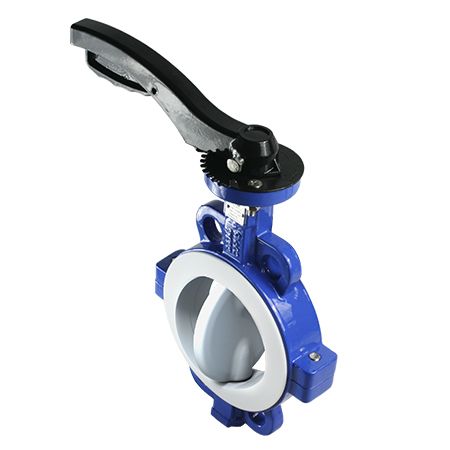
How to choose an industrial butterfly valve
Work through the parameters in decision order, because each one closes off the options below it.
- Fluid and seat. Water, brine and general services take EPDM. Acids, solvents, oxidising media and anything above 120 °C take PTFE or RTFE. Steam, thermal oil and flue gas need a metal seated double offset valve.
- Temperature and pressure class. EPDM stops at roughly 120 °C. PTFE extends the window. Above 200 °C, or above PN16, the resilient seated design is out and the high performance range applies, up to class 300 and 600 °C.
- Size. Butterfly valves win on price and weight from DN100 upwards against an equivalent ball valve. Below DN50 the advantage disappears and a ball valve usually costs less to install.
- Mounting. Wafer for a line that will not be broken, lug for end of line duty or dismantling one side, double flanged for large bore and high mechanical load, clamp for sanitary process.
- Duty: isolation or control. A butterfly disc only modulates usefully between 30° and 70° of opening. Outside that window flow barely responds to travel, and at small openings cavitation attacks the seat.
- Actuation. Size the actuator on breakaway torque with margin, never on nominal torque. Torque scales with DN, differential pressure and seat type.
If you already know DN, pressure and fluid, the fastest route is the butterfly valve configurator, which builds the exact code for body, disc, seat and actuation.
Applications and sectors
KTN butterfly valves are installed wherever a large bore line has to be isolated in a short face to face. Resilient seated valves dominate water treatment, desalination, cooling circuits, HVAC risers, fire mains and general utilities. Aluminium bronze discs are specified for seawater, where AISI 316 would pit.
PTFE seated and high performance valves cover petrochemical and chemical process, oil and gas, power generation, steam and thermal oil headers, pulp and paper, and mining slurry headers. Sanitary clamp valves serve food and beverage, pharmaceutical and cosmetics lines, where the joint has to be stripped and cleaned without tools.
For potable water duty a WRAS certificate is available on the resilient seated range. Any other approval is confirmed project by project rather than assumed.
Butterfly valve types we manufacture
KTN manufactures four body styles. The difference between them is structural, and it decides how the line behaves during maintenance.
| Type | Mounting | End of line service | Dismantle one side without draining | Typical sizes | Choose it when |
|---|---|---|---|---|---|
| Wafer | Centred between flanges on through bolts | No | No | DN40 to DN300 | Lowest cost isolation on a line that stays assembled |
| Lug | Threaded lugs, each flange bolted independently | Yes | Yes | DN40 to DN300 | End of line, pump or filter branches, sectioning duty |
| Double flanged | Full integral flanges on the body | Yes | Yes | DN200 to DN600 | Large bore and high mechanical or bending load |
| Sanitary clamp | Clamp ferrule ends | Yes | Yes | DN25 to DN100 | Food, beverage and pharmaceutical process needing quick strip down |
| High performance (double offset) | Wafer, lug or flanged, API 609 | Depends on body style | Depends on body style | DN50 to DN1200 | Class 150/300, 600 °C, steam, hydrocarbons, fire safe duty |
Wafer type butterfly valves
The body is centred between two flanges and the studs pass right through it. It is the cheapest and lightest option, and the right one when the pipework downstream will not be dismantled. Browse the wafer type butterfly valves.
Lug type butterfly valves
Threaded lugs let each flange be bolted to the body on its own set of studs. That allows the downstream pipe to be removed with the valve closed and the line still full, and it allows genuine end of line installation. See the lug type butterfly valves.
Sanitary clamp butterfly valves
Clamp ferrule ends, stainless body and a moulded seat that can be replaced in seconds without tools. Full range at clamp end butterfly valves.
Double flanged butterfly valves
Double flanged bodies carry integral flanges and are the option for large bore headers where the valve takes bending load from the pipework. KTN manufactures them to order in the DN200 to DN600 band; ask for the drawing when you request a quotation.
What a butterfly valve is and how it works
A butterfly valve is a quarter turn valve in which a circular disc rotates on a shaft across the bore. Ninety degrees of rotation takes it from fully closed to fully open, which is why it needs a lever or a compact gearbox rather than a multi turn handwheel.
In the resilient seated design the seat is a moulded elastomer or polymer liner. The disc seals by interference against that liner all the way round, and the liner also acts as the flange gasket. The shaft is concentric with the pipe axis, so the disc rubs on the seat during the whole travel. That rubbing is what limits pressure, temperature and cycle life.
In the double offset design the shaft sits behind the sealing plane and off the pipe centreline. Those two offsets lift the disc clear of the seat as soon as it starts to open. Friction disappears, operating torque drops and seat life multiplies, which is what allows class 300, metal seats and 600 °C service.
One point that gets missed at design stage: the disc stays in the flow path even when the valve is fully open, so it always adds head loss. Allow for it in pump suction lines, and check that a large disc has room to swing clear of a reducer or a short necked flange.
Materials, discs and seats
KTN builds resilient seated bodies in GG25 cast iron, GGG40 ductile iron, carbon steel or stainless steel, with an AISI 316 disc as standard and aluminium bronze for seawater. Shafts are stainless steel throughout. High performance bodies are cast in A216 Gr. WCB, A351 Gr. CF8 or A351 Gr. CF8M, with hard chrome plated CF8 or CF8M discs and a one piece A182 F6A, F304 or F316 shaft. Alloy 20, Hastelloy C276, duplex A890 6A and Monel are cast on request.
The seat decides the service window more than the body does.
| Seat | Typical fluids | Temperature | Do not use for |
|---|---|---|---|
| EPDM | Water, potable water, brine, glycol, HVAC, general services | Up to approx. 120 °C | Mineral oils, hydrocarbons, thermal oil |
| PTFE | Acids, alkalis, solvents, aggressive chemicals, food process | Wider window than EPDM, into high performance range | Abrasive slurries at high cycle rates |
| RTFE (graphite or glass fibre filled) | Process duty needing more creep resistance than virgin PTFE | High performance range | Ultra pure duties where fillers are not accepted |
| MPTFE / UHMWPE | Chemical service, abrasion resistant duty | High performance range | High temperature steam |
| Metal seated (single or double) | Steam, thermal oil, flue gas, hot hydrocarbons | Up to 600 °C | Duties demanding bubble tight zero leakage on soft seat class |
| NBR / Viton | Oils and specific chemical compatibility, on request | Per compound | Media outside the compound datasheet |
Fire safe seat arrangements to API 607 are available on the high performance range, and every valve is tested to API 598 or ISO 5208.
Connections, standards and actuation
Flange drilling follows DIN/EN 1092-1 in PN10 and PN16, and ANSI/ASME B16.5 class 125/150, on the resilient seated range. The high performance range covers PN10 to PN64, ANSI class 150 and 300, and JIS 10K and 16K, with face to face to API 609, MSS SP-68 or ISO 5752.
EN 593 is the European reference standard for metallic butterfly valves and EN 12266-1 the pressure test applied to them. KTN issues certification against either on request, alongside the 3.1 material certificate and the certificate of origin, and the high performance range is tested to API 598 and ISO 5208.
| Range | Sizes | Pressure classes | Face to face | Design and test |
|---|---|---|---|---|
| Resilient seated wafer / lug | DN40 to DN300 | PN10, PN16, ANSI 125/150 | EN 558 short pattern | Shell and seat tested before dispatch |
| Resilient seated double flanged | DN200 to DN600 | PN10, PN16 | EN 558 | Shell and seat tested before dispatch |
| Sanitary clamp | DN25 to DN100 | Per clamp rating | Clamp ferrule | Shell and seat tested before dispatch |
| KTN V-Type high performance | DN50 to DN1200 (2″ to 48″) | PN10 to PN64, ANSI 150/300, JIS 10K/16K | API 609, MSS SP-68, ISO 5752 | ASME B16.34, API 598, ISO 5208, fire safe API 607 |
If you work in inches, use the DN to inches conversion table before ordering, and check the gasket contact surface against the flange face types guide, since a raised face flange against a resilient seated wafer body needs checking.
Actuation is a multi position lever with locking plate, a worm gearbox with handwheel in ratios from 1:40 to 1:125, or a pneumatic or electric actuator on the ISO 5211 pad. Complete assembled packages are listed under valve automation.
Buying butterfly valves direct from the manufacturer
KTN sells from its own plant, so there is no distributor margin between the casting and your purchase order, and specials are made to your drawing instead of being refused. Every order ships with a certificate of origin, and EN 10204 3.1 material certificates are issued on request.
To quote a butterfly valve we need seven data points:
- Nominal size (DN or inches) and pressure class or PN
- Service pressure and temperature, including any upset condition
- Fluid, concentration and whether it carries solids
- Body style: wafer, lug, double flanged or sanitary clamp
- Body and disc material
- Seat material
- Manual operation (lever or gearbox) or actuator, with the signal and supply available
Send those and you get a firm price with materials and delivery. Build the code yourself in the butterfly valve configurator, or send the line list through the contact page. You can also call +34 937 818 219 between 8:00 and 19:00 CET. Distributor and OEM enquiries are welcome, and we quote export orders in full.
Why choose KTN as your butterfly valve manufacturer
KTN Valves (Kara Technology News, S.L.) is a manufacturer with its plant in Rubí, Barcelona, at Ctra. Rubí-Sabadell km 13, nave 7, 08191. Production runs under ISO 9001, with Bureau Veritas inspection available on request.
Three things follow from manufacturing in Europe rather than trading imported stock. Traceability is real: heat numbers, material certificates and certificate of origin travel with the valve. Specials are viable, because the same plant that casts the standard range machines the one off. And the common sizes and materials sit in stock for immediate dispatch instead of waiting on a container.
Related categories
Butterfly valves sit inside the KTN industrial valves catalogue. For full bore isolation below DN100, see ball valves. For throttling and fine regulation, globe valves and control valves. For straight through isolation on long, infrequently operated lines, gate valves. To stop reverse flow, check valves. Gaskets, studs and spares are in industrial accessories.
Send KTN your DN, pressure class, fluid and service temperature for a quotation straight from the factory, or call +34 937 818 219.
Frequently asked questions
What is a double offset butterfly valve and when do I need one?
A double offset butterfly valve has its shaft set behind the sealing plane and off the pipe centreline. The disc lifts clear of the seat on opening, so friction and torque drop and seat life rises. KTN builds them to API 609 and ASME B16.34 from DN50 to DN1200, class 150 and 300, for -29 °C to 600 °C. Choose one above PN16, above 120 °C or for steam and hydrocarbons.
Do you manufacture CF8M and CF8 double offset butterfly valves?
Yes. KTN casts high performance double offset bodies in A351 Gr. CF8M, A351 Gr. CF8 and A216 Gr. WCB, with hard chrome plated CF8 or CF8M discs and a one piece A182 F6A, F304 or F316 shaft. Alloy 20, Hastelloy C276, duplex A890 6A and Monel are available on request. Face to face follows API 609, MSS SP-68 or ISO 5752.
What temperature does a PTFE butterfly valve seat take?
A PTFE seat covers a wider window than EPDM, which stops at around 120 °C, and handles acids, alkalis and solvents that would attack rubber. For sustained high temperature service KTN uses RTFE with graphite or glass fibre, MPTFE, or a metal seat in the high performance range, which reaches 600 °C. Tell us the exact service temperature and we confirm the seat.
What is the difference between wafer type and lug type butterfly valves?
A wafer valve is centred between the flanges on through bolts, so removing the downstream pipe releases the joint and drains the line. A lug valve has threaded lugs and each flange bolts to the body independently. That lets you dismantle one side with the line full and install the valve at end of line. Lug costs more; wafer is lighter and cheaper.
Do you supply sanitary clamp butterfly valves?
Yes. KTN manufactures sanitary butterfly valves with clamp ferrule ends in stainless steel, DN25 to DN100, with moulded seats that are replaced by hand without tools. They are used in food, beverage, pharmaceutical and cosmetics process lines where the joint must be stripped and cleaned frequently. Handles can be multi position lever or pneumatic actuator on an ISO 5211 pad.
Do you make carbon steel butterfly valves for high temperature service?
Yes. Carbon steel resilient seated bodies are available, and the high performance range is cast in A216 Gr. WCB carbon steel with metal or RTFE seats for service to 600 °C, class 150 and 300. Fire safe arrangements follow API 607 and testing follows API 598 or ISO 5208. Send the design and upset temperatures so the seat is selected correctly.
How do I get a butterfly valve price from the factory?
Send seven items: DN or inches, pressure class, service pressure and temperature, fluid, body style (wafer, lug, double flanged or clamp), body and disc material, seat material, and manual or actuated operation. Use the KTN butterfly valve configurator or the contact form, or call +34 937 818 219 from 8:00 to 19:00 CET. Distributor and export enquiries are quoted in full.